 Westie Bakse
Westie Puppy: The First 100 Days
Day one, Bakse was scared of the hallway. By day one hundred, she was digging to the other side of the planet. This is what the first 100 days with our Westie puppy really looked like, with the facts we wish we had known before.
Day 1: coming home
Bakse came home at about 8 weeks old, roughly the size of a loaf of bread and completely sure she was in charge. The first thing she did? Drank half the water bowl, sniffed every corner and then very carefully avoided the hallway.

Young puppies can sleep 18 to 20 hours a day (AKC), so for the first few days, that is mostly what she did.
Week 1: toys, naps and belly rubs
Her first night went better than we expected. She slept well, with a few puppy dreams and twitches. Many owners say their puppy cries for about a week; Bakse was simply excited from day one.
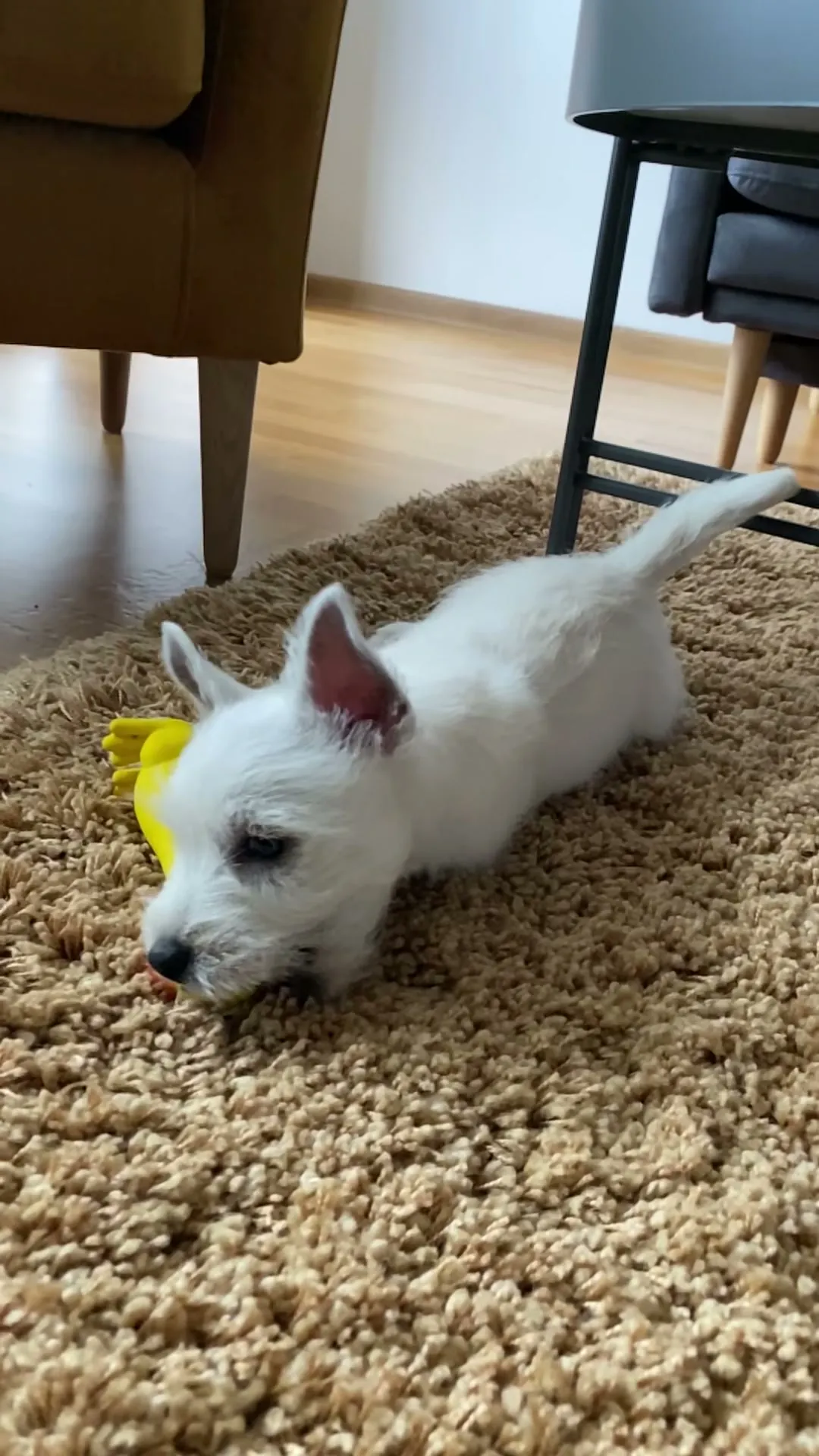
By day three she had a favorite toy, a yellow rubber duck she fought like it owed her money. Lying on her back for belly rubs became her signature move. Dogs often lie like this when they feel relaxed and comfortable, so we took it as a good sign.
Why not outside straight away?
Puppies typically get core vaccine doses every 2 to 4 weeks until at least 16 weeks of age (PetMD). The exact schedule varies by country and vet, so ask yours. For the first weeks Bakse stayed mostly at home and on the balcony, and we practiced the leash indoors. She was not impressed.
Her first friend
Her first real friend was Dija, a toy poodle. Bakse was half the poodle's size and twice as loud. Westies were bred to hunt small animals, including rodents and foxes, so gentle play is a learning process, especially for a puppy.

Weeks 2 to 4: pure chaos (and teeth)
She met herself in the mirror and lost the argument. We put up a baby gate, and she made it very clear what she thought about that. When we had to leave, we watched her on a camera. Very young puppies can only manage short periods alone at first, so we built it up slowly.
Then came the teeth: shoes, socks, slippers. Puppy teeth start falling out at around 3 to 4 months and the adult set is usually complete by about 6 months (AKC). Until then, nothing is safe. Training started with treats: Westies are smart but very independent, or as the breed club puts it, "energetic, not hyper".
Day 30: hello, world
Around day 30 she finally went out into the real world: forest, sand, other dogs, cars. Everything was new and everything had to be sniffed. The key socialization window is roughly the first 3 to 14 weeks, so we showed her as much as we safely could: big dogs, small dogs, people and noises.

Her first summer
The beach came next. She ran straight at the waves, then straight back. We took her paddle boarding (yes, she has her own little life jacket), and around day 70 she went kayaking and somehow ended up swimming.

The terrier comes out
This is when the terrier really showed up. Westies were bred to dig rats out of holes (AKC). Nobody told the sandpit.

Day 100
Bigger, braver, a lot dirtier, and she had just met three other Westies for the first time.

What we would tell a new Westie owner
- Be patient: the independent streak is part of the breed.
- Hide your shoes until the adult teeth are in.
- Socialize early and gently, within what your vet allows.
- Keep alone time short at first and build it up slowly.
- Film everything. You will want to remember this.
Westie puppy FAQ
How much does a Westie puppy sleep?
Puppies in general sleep around 18 to 20 hours a day, in naps. Bakse did exactly that in her first weeks.
When do Westie puppies stop teething?
Baby teeth start falling out at about 3 to 4 months, and most puppies have all their adult teeth by around 6 months.
When can a Westie puppy go outside?
It depends on the vaccine schedule, which usually runs until about 16 weeks. Ask your vet when it is safe, and use the time before that for gentle socialization at home.
How long can a Westie puppy be left alone?
Very young puppies can only manage short periods alone at first. Increase it step by step.
How big does a Westie get?
An adult Westie is usually about 25 to 28 cm (10 to 11 inches) tall and around 7 to 9 kg (15 to 20 lb).
Every puppy is different. Facts come from the AKC, PetMD, PDSA and the Westie Club; for anything about your own dog, check with your vet.