Some links below are affiliate links - we may earn a small commission at no extra cost to you. We only recommend food that has actually been in Bakse's bowl.
If you've just brought home a Westie, save yourself a few months of trial and error: what you feed a West Highland White Terrier shows up on their skin. When we got Bakse, we fed him a popular supermarket kibble - and got a dog who scratched, licked his paws and had reddish stains around his muzzle. Once we fixed the bowl, most of it went away.
Here's everything we've learned about feeding a Westie, including exactly what Bakse eats today.
After trying several kibbles, we've landed on ZEAL air-dried food as Bakse's main meal. It's made in New Zealand from grass-fed meat and fish, with no artificial preservatives - closer to raw feeding, but shelf-stable and zero prep. Two things sold us:
Air-dried food costs more per bag than kibble, but for a small dog like a Westie the bag lasts - we spend about $60/month. Check ZEAL's current range here (new customers usually get a first-order discount).
We keep treats single-ingredient: dried fish skins, venison bits, carrot sticks. Rule of thumb - if you can't tell what animal it came from, Bakse doesn't get it. Treats stay under 10% of daily calories.
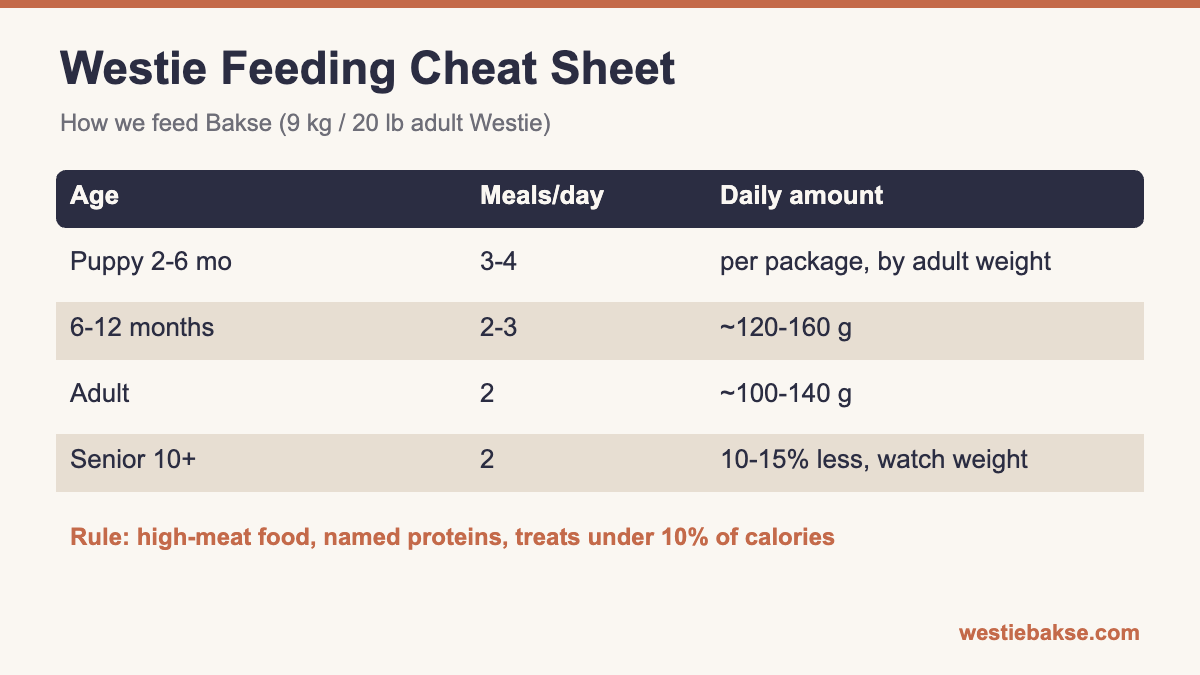
| Westie age | Meals/day | Daily amount (dry/air-dried) |
|---|---|---|
| Puppy (2-6 months) | 3-4 | Follow package by expected adult weight |
| 6-12 months | 2-3 | ~120-160 g split across meals |
| Adult (9-10 kg) | 2 | ~100-140 g depending on activity |
| Senior (10+ years) | 2 | Reduce ~10-15%, watch weight |
Bakse eats twice a day, morning and evening, always after his walk. Fresh water always available - especially with air-dried food.
Change over 7-10 days: 25% new food for a few days, then 50%, then 75%, then full. When we rushed it once, we regretted it on the living-room rug. Go slower if your Westie has a history of soft stools.
Good signs after 4-8 weeks: less scratching and paw-licking, whiter coat, small firm stools, steady energy.
Red flags: constant itching, ear infections, reddish-brown paw stains, gas, dull coat - time to reassess the bowl and talk to your vet. Persistent issues may be environmental allergies, not food - more in our skin problems guide.
Limited-ingredient food with a novel protein (fish, venison, lamb) and no artificial additives. Air-dried or high-quality kibble both work - the ingredient list matters more than the format.
Not automatically. Wheat can be a trigger for some Westies, but grain-free isn't a cure-all - and your vet should weigh in, since grain-free diets have their own debates. Focus on overall ingredient quality.
Many can - but chicken is among the most common triggers for itchy Westies. If your dog scratches, a chicken-free trial is the classic first step.
$40-$80/month for quality food in the US. See our full Westie cost breakdown.